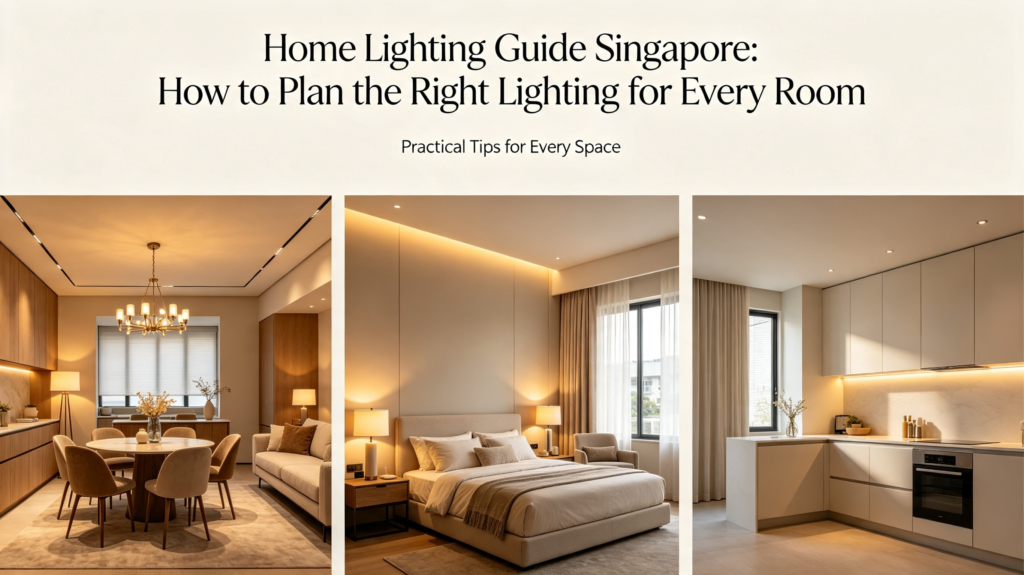
Home Lighting Guide Singapore: How to Plan the Right Lighting for Every Room
Good lighting does much more than brighten a home.
The right lighting can make a small room feel more spacious, create a comfortable atmosphere at night, highlight interior features and make everyday activities such as cooking, reading and working much easier.
However, one of the most common mistakes homeowners make during renovation is treating lighting as something to decide at the end.
By then, the ceiling design, electrical points, carpentry and furniture positions may already have been confirmed.
A better approach is to plan lighting together with the layout of your home.
This guide covers the important things homeowners should consider when planning lighting for a new or renovated home in Singapore.
Start With the Room, Not the Light Fixture
It can be tempting to begin by choosing attractive pendant lights, track lights or ceiling lamps.
Instead, start by asking:
- What will this room be used for?
- Where will the furniture be positioned?
- Which areas need stronger illumination?
- Where should the atmosphere feel softer?
- Are there walls, furniture or architectural features worth highlighting?
- How much natural daylight enters the space?
A living room used mainly for watching television needs a different lighting arrangement from one that also functions as a reading area, workspace and entertainment space.
Once the activities are clear, selecting suitable lighting becomes much easier.
The Three Layers of Home Lighting
A comfortable home normally does not depend on one powerful ceiling light.
Instead, different types of lighting can work together.
1. General Lighting
General lighting provides the main illumination for moving around and using the room normally.
Common examples include:
- Ceiling lights
- Recessed downlights
- Surface-mounted lights
- Cove lighting
- Chandeliers
General lighting forms the foundation, but it does not necessarily need to be the most visually interesting light in the room.
2. Task Lighting
Task lighting concentrates light where a particular activity takes place.
Examples include:
- Kitchen counter lighting
- Study desk lamps
- Reading lights beside the bed
- Vanity mirror lighting
- Pendant lights above an island
- Lights above working surfaces
Good task lighting is particularly important in areas where visibility affects comfort and practicality.
3. Feature and Accent Lighting
Accent lighting is used to create atmosphere or draw attention to selected areas.
It can highlight:
- Feature walls
- Artwork
- Display cabinets
- Fluted wall panels
- Decorative surfaces
- Plants
- Shelving
- Architectural details
Track lights, spotlights, wall lights and concealed LED strips are commonly used for this purpose.
The best results usually come from combining these three layers rather than relying entirely on one lighting source.
Understanding Light Colour Temperature
Have you ever entered one home that feels warm and relaxing while another feels bright and energetic?
Part of that difference comes from
colour temperature.
Colour temperature is measured in Kelvin (K).
Warm White
Approximately
2700K–3000K
Warm white creates a softer and more relaxing atmosphere.
It works particularly well in:
- Bedrooms
- Living rooms
- Dining areas
- Relaxation spaces
It is commonly used when homeowners want a cosy, hotel-like interior.
Neutral White
Approximately
3500K–4000K
Neutral white provides a cleaner appearance while remaining comfortable for residential use.
It can work well in:
- Kitchens
- Bathrooms
- Study areas
- Wardrobes
- Multipurpose spaces
Cool White
Approximately
5000K and above
Cooler lighting produces a brighter and more clinical appearance.
While useful where strong visibility is required, using too much cool white throughout a home can make residential spaces feel less relaxing.
There is no requirement for every room to use exactly the same colour temperature. The choice should correspond to how the space is used and the atmosphere you want to create.
Brightness: Don’t Choose Lights Based Only on Wattage
A higher wattage does not automatically mean that a light will provide the right amount of illumination.
When comparing modern lighting, homeowners should also look at
lumens.
Lumens indicate the amount of visible light produced by a light source.
The amount required depends on factors such as:
- Room dimensions
- Ceiling height
- Number of lighting points
- Wall and flooring colours
- Furniture
- Natural daylight
- Type of light fixture
- Purpose of the room
Dark surfaces absorb more light, while lighter surfaces generally reflect more light.
This means two rooms of exactly the same size may still require different lighting arrangements.
Lighting the Living Room
The living room usually has several functions.
It may be used for:
- Watching television
- Relaxing
- Entertaining visitors
- Reading
- Dining
- Family activities
Because of this, using only one central ceiling light can be limiting.
A more flexible arrangement could combine general ceiling lighting with accent lights and softer indirect illumination.
For example:
General lighting: Downlights or ceiling lights
Feature lighting: Track lights aimed towards a feature wall
Ambient lighting: Cove or concealed LED lighting
Decorative lighting: Pendant or floor lamp
Different groups of lights can also be connected to separate switches, allowing homeowners to change the atmosphere without turning on everything simultaneously.
Lighting Around the TV
More brightness is not necessarily better around a television.
Strong lights positioned directly above or opposite the screen can create unwanted reflections and glare.
Instead, softer surrounding illumination can make television viewing more comfortable.
Possible options include:
- Indirect cove lighting
- Concealed lighting behind the TV feature wall
- Wall washing
- Side lighting
- Dimmable ambient lighting
The objective is to provide enough surrounding light without competing with the television screen.
Dining Area Lighting
The dining table naturally creates an opportunity for decorative lighting.
Pendant lights are particularly effective because they visually define the dining zone, especially in open-plan living and dining areas.
The fixture should be positioned according to the dining table rather than simply according to the centre of the room.
This is why furniture planning should ideally happen before electrical points are finalised.
Warm lighting can also make dining spaces feel more comfortable and inviting.
Bedroom Lighting
Bedroom lighting should support relaxation while still providing enough illumination for practical activities.
A combination may include:
- Main ceiling light
- Cove lighting
- Bedside reading lights
- Wardrobe lighting
- Vanity lighting
- Small decorative lamps
Bedside switches are another practical consideration.
Being able to control selected lights without walking back to the entrance can significantly improve everyday convenience.
For homeowners who read in bed, directional bedside lights can provide focused illumination without lighting the entire bedroom.
Kitchen Lighting
The kitchen is one area where functionality should take priority.
A common problem occurs when ceiling lights are installed behind the person using the countertop.
The person then blocks the light and creates a shadow directly over the working surface.
Consider dedicated lighting for:
- Food preparation counters
- Sink area
- Hob area
- Kitchen island
- Cabinets
- Pantry
Under-cabinet lighting can be particularly useful because it illuminates the countertop directly.
Decorative pendant lights can then be added above an island or breakfast counter without being responsible for all of the functional lighting.
Bathroom Lighting
Bathroom lighting needs to serve several different purposes.
General ceiling lighting provides overall visibility, while the vanity area benefits from dedicated illumination.
When lighting a mirror, consider how the light falls on the face.
Poor positioning can create strong shadows, making grooming, shaving or applying makeup more difficult.
Bathroom lights should also be selected according to the conditions and installation area, particularly where moisture or direct water exposure may occur.
Entrance and Corridor Lighting
Entrances and corridors are sometimes overlooked because homeowners spend less time there.
However, these spaces strongly influence the first impression of a home.
Lighting can be used to highlight:
- Entrance feature walls
- Artwork
- Mirrors
- Display niches
- Decorative panels
- Shoe cabinets
For long corridors, multiple smaller lighting points can create a more balanced result than one extremely bright source.
Cove Lighting: Creating Softer Indirect Light
Cove lighting conceals the light source and allows illumination to reflect from the ceiling or surrounding surfaces.
Instead of seeing the light directly, you see its glow.
This can create a softer atmosphere and reduce harsh contrast.
Cove lighting works particularly well in:
- Living rooms
- Bedrooms
- TV areas
- Dining spaces
- Feature ceilings
However, the ceiling detail and electrical requirements need to be planned before construction.
Track Lights: Flexible Feature Lighting
Track lighting provides greater flexibility because individual light heads can usually be repositioned.
They can be directed towards:
- Paintings
- Feature walls
- Display shelves
- Decorative panels
- Furniture
- Specific corners of a room
This makes track lighting particularly useful when homeowners want to create visual emphasis without installing numerous fixed lighting points.
The important part is deciding
what the track light is supposed to illuminate rather than simply pointing every light towards the floor.
Consider Natural Daylight
Artificial lighting should not be planned without considering daylight.
Observe:
- Which rooms receive morning sunlight
- Which areas become dark during the afternoon
- Window positions
- Curtain or blind types
- Nearby buildings blocking daylight
- Dark corners within the home
A room that receives strong daylight may require artificial lighting mainly during the evening, while an enclosed corridor or internal room may depend on artificial illumination throughout the day.
Plan Your Switches Properly
A good lighting design can become inconvenient if the switches are poorly planned.
Consider:
- Which lights should operate together?
- Which lights should have separate controls?
- Do you need control from more than one location?
- Should any lights be dimmable?
- Where will you naturally reach for the switch when entering the room?
Instead of connecting every living room light to one switch, for example, separating general, feature and ambient lighting gives homeowners much greater control.
You may want bright general lighting when cleaning but only soft ambient lighting when watching a movie.
When Are Dimmers Useful?
Dimmers allow the brightness of compatible lighting to be adjusted.
They can be useful in:
- Living rooms
- Bedrooms
- Dining areas
- Entertainment spaces
A dining area might require brighter illumination during cleaning but softer lighting during dinner.
Likewise, a living room may need different brightness levels for entertaining guests and watching television.
If dimming is required, the light fitting, driver and dimmer should be compatible with one another.
Plan Lighting Before Carpentry and Ceiling Work
This is one of the most important parts of lighting planning.
Electrical and lighting positions can affect:
- False ceilings
- Cove details
- Built-in cabinets
- TV feature walls
- Wardrobes
- Kitchen cabinets
- Mirrors
- Curtains
- Ceiling fans
Changing electrical points after carpentry or ceiling work has been completed can create additional work.
Before renovation begins, it is useful to have a plan showing:
Furniture → Carpentry → Lighting → Switches → Electrical points
These elements should work together rather than being planned independently.
Common Home Lighting Mistakes
Too Many Downlights
Installing more lights does not automatically create better lighting.
Too many downlights can make a ceiling look cluttered and create unnecessary brightness.
Using One Colour Temperature Everywhere
Different spaces have different purposes. The lighting atmosphere should reflect those purposes.
Ignoring Furniture Positions
A pendant light that looks perfectly centred in an empty room may look completely misplaced after the dining table is installed elsewhere.
Forgetting Task Lighting
A room can look bright overall while still having poor visibility exactly where work is being performed.
Overlooking Glare
Direct exposure to very bright light sources can be uncomfortable, especially around beds, sofas, televisions and reflective surfaces.
Making Every Light Operate Together
Separating lighting into different circuits or switch groups gives homeowners considerably more flexibility.
A Simple Room-by-Room Lighting Checklist
Before confirming your lighting plan, check each room.
Living Room
- General illumination
- TV viewing lighting
- Feature wall lighting
- Optional ambient lighting
Dining Area
- General illumination
- Dining table lighting
- Decorative or pendant lighting
Bedroom
- Main lighting
- Bedside lighting
- Wardrobe or vanity lighting
- Comfortable night-time lighting
Kitchen
- General lighting
- Countertop lighting
- Sink and hob visibility
- Island lighting where applicable
Bathroom
- General lighting
- Mirror/vanity lighting
- Suitable lighting for wet areas
Entrance & Corridor
- General visibility
- Feature lighting where required
- Convenient switch positions
Final Thoughts
A successful home lighting plan is not about installing as many lights as possible or choosing the most expensive fixtures.
It is about putting the
right type of light in the right place for the right purpose.
Start with how each room will be used. Then consider furniture positions, natural daylight, colour temperature, brightness, task requirements and the atmosphere you want to create.
Most importantly, lighting should be planned early together with the electrical layout, ceiling and carpentry.
When these elements work together, lighting becomes more than a practical necessity. It becomes part of the interior design itself — helping your home feel brighter when you need it, warmer when you want to relax, and more comfortable every day.